
Warming up before strength training

A few arm swings and straight to the working weight - a familiar picture in many gyms. But a proper warm-up not only reduces the risk of injury, it also directly affects strength in the working sets. The editorial team explains what happens in the body during a warm-up, how to structure it in 10-15 minutes and whether to stretch before training.
Why a warm-up is needed
A warm-up is the preparatory part of a workout whose goal is to bring the body from a state of rest to a state of readiness for intense work. For strength training this is especially important: working with large weights requires a high muscle temperature, good joint mobility and clear coordination.
The physiological effects of a warm-up are well described in the review by Bishop (2003). An increase in muscle temperature accelerates enzymatic reactions and the conduction of nerve impulses, reduces tissue viscosity and facilitates contraction. In parallel, blood flow in the working muscles increases and oxygen delivery improves.
The neuromuscular component is no less important. Performing a movement with gradually increasing weight 'tunes' the nervous system to the specific exercise, improves coordination and makes it possible to assess how you feel that day. Some athletes also note a 'potentiation' effect - a temporary increase in strength after heavy preparatory repetitions.
The systematic review and meta-analysis by Fradkin, Zazryn and Smoliga (2010) showed that a warm-up improved physical performance in most of the cases studied. A warm-up usually did no harm, except in situations where it was too exhausting.
The structure of an effective warm-up
A practical warm-up for strength training consists of three parts: general, dynamic and specific. Each has its own task, and together they take 10-15 minutes.
| Stage | Duration | What to do | Goal |
|---|---|---|---|
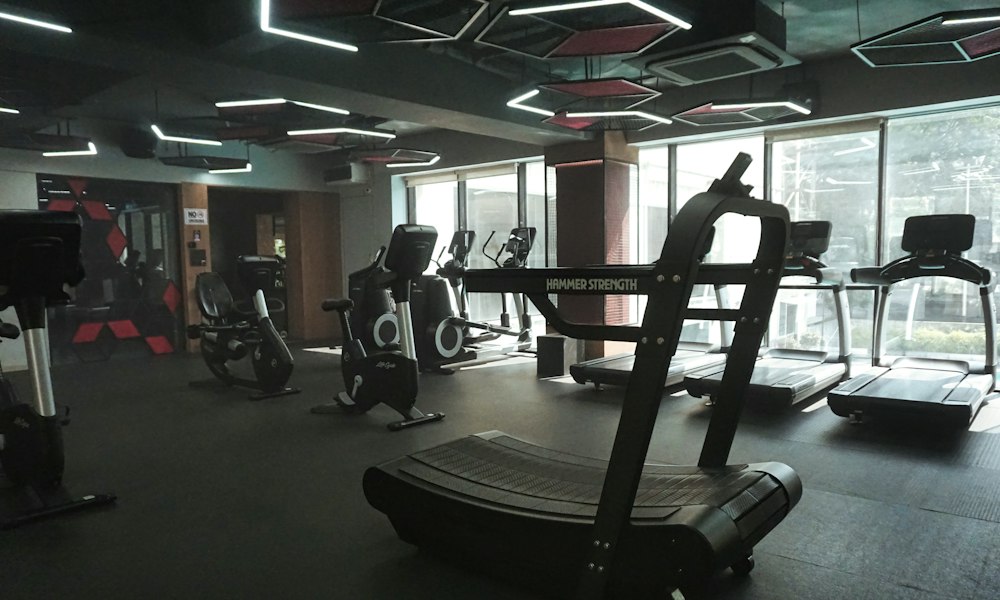
| General warm-up | 5-7 min | Stationary bike, elliptical, brisk walking, jump rope | Raising body temperature and heart rate |
| Dynamic mobilization | 3-5 min | Leg swings, rotations, lunges, 'cat-cow,' bodyweight squats | Joint mobility, muscle activation |
| Specific warm-up | 5-10 min | Warm-up sets in the first exercise with gradually increasing weight | Technical and neural preparation |
The general part should be light: the goal is to slightly 'warm up' the body to a feeling of warmth and light sweating, not to get tired. The intensity is roughly the level at which you can talk, but already with some effort.
Dynamic mobilization is selected to match the day's workout. Before squats, movements for the hip and ankle joints are useful; before presses, for the shoulder girdle and thoracic spine. The goal is to go through the working range of motion, not to stretch maximally.
The specific warm-up is the most important for strength training. It consists of performing the first working exercise with light weights that gradually approach the working weight. The number of repetitions decreases at the same time so as not to accumulate fatigue.
Warm-up sets: how to build them
Warm-up sets make it possible to rehearse technique and prepare the joints and nervous system. The heavier the working weight, the more warm-up sets are needed. For light or medium work 1-2 are enough, for heavy basic exercises 3-5.
The general scheme: the first set is with an empty bar or a very light weight for 8-10 repetitions, then increasing the weight with a gradual reduction in repetitions. The last warm-up set is close to the working weight for 1-2 repetitions.
Rest between warm-up sets is short - 30-90 seconds, only on the last, heavy sets should it be increased. The goal is to prepare, not to expend energy.
For the subsequent exercises in a workout 1-2 warm-up sets are often enough, since the body is already warmed up. The exception is exercises for other muscle groups or with different biomechanics, for example the transition from squats to presses.
The study by McCrary, Ackermann and Halaki (2015) on warming up the upper body concluded that a dynamic warm-up and a warm-up with gradually increasing load improve strength performance, whereas there is no evidence of the effectiveness of static stretching for this.
Static stretching: harmful or not
For a long time it was believed that static stretching before a workout reduces the risk of injury. Then data appeared that it temporarily reduces strength and power, and the pendulum swung the other way. The meta-analysis by Simic, Sarabon and Markovic (2013) confirmed that static stretching before a load on average reduces maximal strength, with the effect being greater with prolonged holding of the position.
Later reviews refined the picture. Behm and Chaouachi (2011) and Behm et al. (2016) showed that the negative effect mainly manifests with prolonged (over 60 seconds per muscle group) stretching, whereas short series, especially combined with a dynamic warm-up, have a minimal or negligible effect on performance.
The practical conclusion: if an athlete feels the need for static stretching before a workout (for example, to achieve the required range of motion in a squat), short series of 15-30 seconds per group, performed before the dynamic part of the warm-up, are unlikely to do harm.
Prolonged static stretching is better moved to the end of the workout or to separate sessions for developing flexibility.
- short static stretching (up to 30 s) - permissible if needed;
- prolonged holding (over 60 s per muscle) before strength work - undesirable;
- dynamic exercises - the main tool of preparation;
- developing flexibility - separately or after the workout.
Common mistakes and special situations
The most frequent mistake is a complete absence of a warm-up: the athlete goes straight to the working weight. This worsens the technique of the first sets, reduces performance and probably increases the risk of injury, especially in older people.
The opposite extreme is a warm-up that is too long or intense. Twenty minutes of intense cardio before heavy squats can tire the legs and reduce the result. A warm-up should prepare, not exhaust.
Cold weather, early workouts and age require a longer warm-up. After an injury, special exercises for the relevant area, agreed with a rehabilitation specialist, should be added to the warm-up.
Finally, a warm-up is a good 'indicator' of your state. If the warm-up sets feel unusually hard, this is a signal to adjust the day's plan rather than force the working weights.
We also recommend reading our articles on progressive overload, on training to failure and on training periodization.
Editorial conclusions
A warm-up raises muscle temperature, improves mobility and neuromuscular readiness, which in most studies improves performance.
An effective warm-up consists of a general part, dynamic mobilization and warm-up sets in the first exercise and takes 10-15 minutes.
Prolonged static stretching before strength work can temporarily reduce strength, whereas short series combined with a dynamic warm-up do practically no harm.
References
- Fradkin AJ, Zazryn TR, Smoliga JM. Effects of warming-up on physical performance: a systematic review with meta-analysis. J Strength Cond Res. 2010;24(1):140–148.
- Bishop D. Warm up I: potential mechanisms and the effects of passive warm up on exercise performance. Sports Med. 2003;33(6):439–454.
- Behm DG, Chaouachi A. A review of the acute effects of static and dynamic stretching on performance. Eur J Appl Physiol. 2011;111(11):2633–2651.
- Behm DG, Blazevich AJ, Kay AD, McHugh M. Acute effects of muscle stretching on physical performance, range of motion, and injury incidence in healthy active individuals: a systematic review. Appl Physiol Nutr Metab. 2016;41(1):1–11.
- Simic L, Sarabon N, Markovic G. Does pre-exercise static stretching inhibit maximal muscular performance? A meta-analytical review. Scand J Med Sci Sports. 2013;23(2):131–148.
- McCrary JM, Ackermann BJ, Halaki M. A systematic review of the effects of upper body warm-up on performance and injury. Br J Sports Med. 2015;49(14):935–942.
- Haff GG, Triplett NT, eds. Essentials of Strength Training and Conditioning. 4th ed. Human Kinetics; 2016.
Andriy Melnyk
A strength-sports coach and author of programs for beginner and intermediate levels. Writes about training planning.